
The Two-Ingredient Tanning Gummy: Why Simpler Beats Kitchen-Sink Formulas
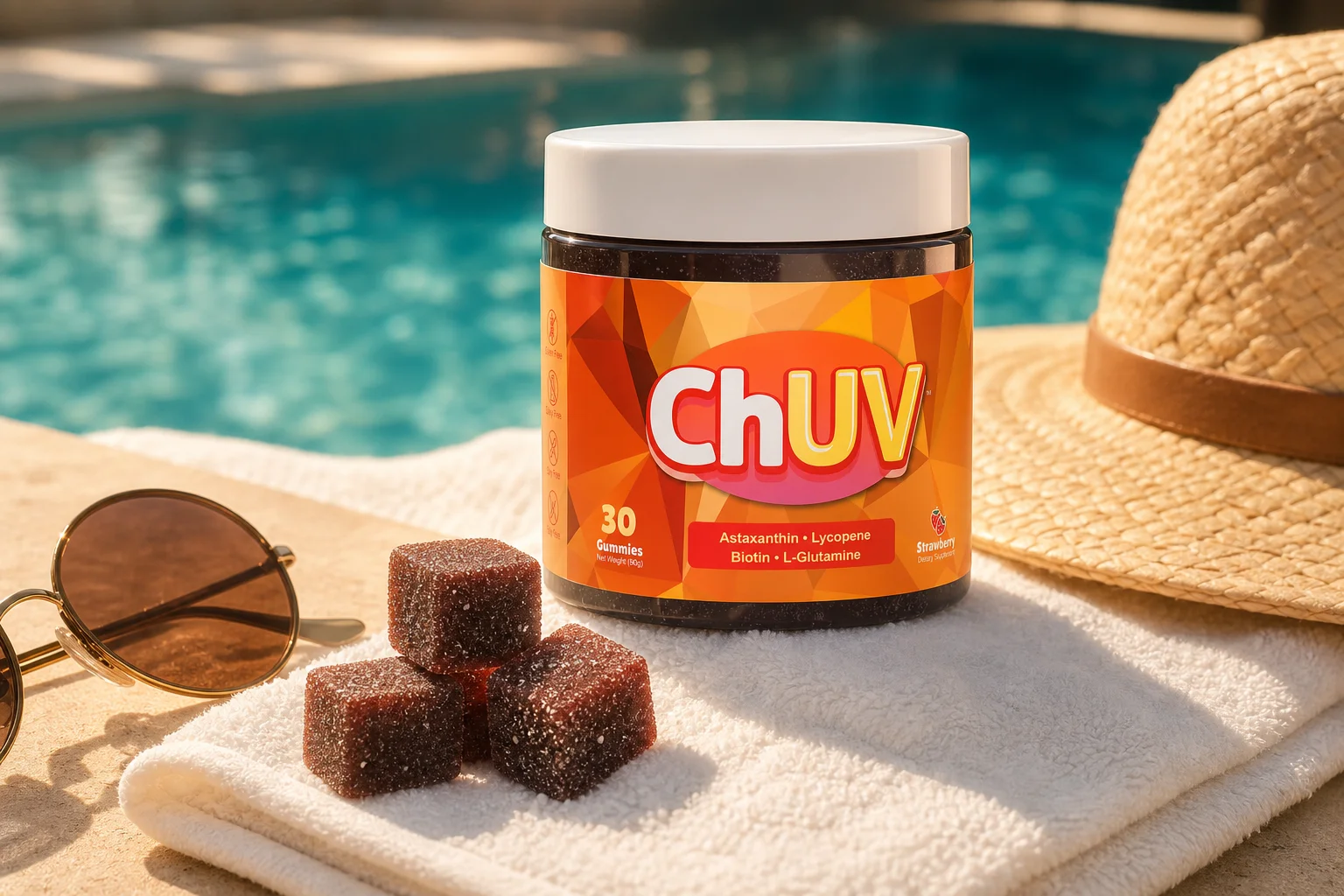
When most tanning gummies load up on a dozen ingredients, ChUV Tanning Gummies takes the opposite approach: the two-ingredient tanning gummy uses only astaxanthin and lycopene, two clinically studied carotenoids, to deliver a natural warm glow and enhanced skin tone without the filler.
By CAYO Nutra Team, Supplement Specialists
What Makes a Two-Ingredient Formula Different?
The supplement industry has a complexity bias. More ingredients on a label tend to look more credible, more comprehensive, more worth the price. But the science of carotenoid absorption tells a different story.
ChUV gummies contain two active carotenoids: astaxanthin and lycopene. That is the whole formula. No fillers, no competing compounds, no proprietary blends that hide actual dosing behind a total weight. Every milligram of active ingredient serves a documented, research-backed purpose.
A two-ingredient philosophy is not a shortcut. It is a commitment to precision. When you limit your active stack to two compounds, you can dose each one correctly, avoid absorption conflicts, and give customers a clear answer: what exactly is in this product, and why?
This matters especially in the tanning supplement category, where many competing products mix astaxanthin with beta-carotene, copper, lutein, lycopene, vitamin C, and vitamin E all at once, often at doses too small to function. The result is a product that looks impressive in a comparison table but underperforms in practice.
Astaxanthin: The Science Behind the Glow
Astaxanthin is a red-orange carotenoid produced by the microalgae Haematococcus pluvialis. It is one of the most well-researched carotenoids for skin health, with a growing body of clinical evidence supporting its role in pigmentation, photoprotection, and skin texture improvement.
Research by Tominaga et al. published in Acta Biochimica Polonica (2012) found that oral astaxanthin supplementation reduced fine lines, age spots, and skin roughness over 16 weeks in female participants. Separate work by Suganuma et al. in the Journal of Clinical Biochemistry and Nutrition (2012) confirmed improvements in skin elasticity and moisture after consistent daily astaxanthin use.
Mechanistically, astaxanthin deposits in both the dermal and epidermal skin layers, where it shifts the light-absorption profile of skin tissue in ways that produce a visually warmer complexion. Because its molecular structure spans the full cell membrane, it functions as a powerful antioxidant on both sides of each cell, quenching free radicals generated by UV exposure at the source.
Unlike beta-carotene, which tends to accumulate unevenly and produce an unnatural yellowish-orange tinting, astaxanthin supports a natural sun-kissed skin tone. This distinction is central to why the two-ingredient tanning gummy formula was built around astaxanthin as its primary carotenoid.
Lycopene and the Art of Complementary Dosing
Lycopene is the second carotenoid in ChUV's formula, and it works through a different mechanism than astaxanthin. That difference is the point.
Best known as the pigment that gives tomatoes their deep red color, lycopene accumulates preferentially in skin tissue compared to most other organs. Research by Stahl et al. published in the Journal of Nutrition (2001) found that lycopene-rich tomato paste consumption significantly reduced skin redness and damage markers following UV exposure in human subjects. This photoprotective effect complements astaxanthin's antioxidant action and supports overall skin health.
From a pigmentation standpoint, lycopene contributes to the warm, gradual shift in skin tone that ChUV is formulated to produce. It does not duplicate what astaxanthin does. The two carotenoids occupy distinct color and protection niches, covering a broader range of the skin's optical response to daily sun exposure.
This is complementary dosing in practice: two ingredients chosen because they work differently, not because they both sound good on a label.

Why Kitchen-Sink Formulas Underperform
Most competing tanning gummies feature five to twelve active ingredients. The appeal is obvious: more ingredients look more comprehensive. But the practical problem is absorption competition.
Carotenoids and other fat-soluble vitamins share the same intestinal receptors during digestion. Research by Borel et al. published in Progress in Lipid Research (2013) demonstrated that high intake of one carotenoid suppresses the plasma absorption of others. A formula listing six carotenoids at modest doses may actually deliver less bioavailable astaxanthin to your skin than a focused two-carotenoid formula at the same total weight.
Beyond absorption, there is the issue of beta-carotene. Many kitchen-sink formulas include beta-carotene alongside lycopene, astaxanthin, copper, and zinc. At high supplemental doses, beta-carotene has been associated with elevated lung cancer risk in smokers, based on the ATBC and CARET clinical trials published in The New England Journal of Medicine in 1994 and 1996. In non-smokers, its most common cosmetic side effect remains carotenodermia: an unnatural yellowish-orange discoloration of the skin. ChUV does not contain beta-carotene.
There is also the matter of hidden dosing. Supplement regulations allow brands to list a proprietary blend as a single line item with one total weight. When a formula contains eight carotenoids, each may supply only trace amounts. A two-ingredient product has no place to hide.
If you want to evaluate any tanning supplement label critically, reading a supplement label is a practical starting point. Before committing to any brand, look for third party lab testing or a certificate of analysis confirming what the product actually contains, and favor labels that disclose individual carotenoid amounts instead of burying them inside a proprietary blend.
What to Expect From the Two-Ingredient Tanning Gummy
The two-ingredient tanning gummy produces gradual, visible results, not overnight change. Carotenoids accumulate in skin tissue over days and weeks of consistent supply, which is why clinical studies typically measure outcomes at the 4-week, 8-week, and 16-week marks.
In practice, most ChUV users notice a shift in their skin tone within 21 to 30 days of daily use. The healthy glow deepens through the first month and into the second, making a consistent daily routine the single most important variable in your results.
To maximize absorption, take your gummy with a meal that includes healthy fats. Carotenoids are fat-soluble and absorb significantly better in the presence of dietary fat than on an empty stomach.
Pair your daily routine with sensible sun exposure. Carotenoids enhance and extend the natural color response of skin to UV light, so moderate, responsible exposure accelerates visible results compared to staying entirely out of the sun. Consistency matters more than any single variable, and building a daily routine around meals and sun exposure is what turns gradual results into steady ones.
Frequently Asked Questions
Why does the two-ingredient tanning gummy outperform formulas with more carotenoids?
Because absorption is the limiting factor. Carotenoids compete for the same intestinal receptors. A formula with six carotenoids often delivers less of each to your bloodstream than a focused two-carotenoid formula at the same total dose. Borel et al. confirmed this receptor competition effect in Progress in Lipid Research (2013), making dose concentration a stronger predictor of results than ingredient count.
How many days before I see results from tanning gummies?
Most users notice their first visible skin tone shift within 21 to 30 days of consistent daily use. Clinical astaxanthin and lycopene studies typically measure at 4 weeks (28 days), 8 weeks, and 16 weeks. Results build gradually, with the most noticeable change occurring through the first full month and continuing into the second.
Does ChUV contain beta-carotene or copper?
No. ChUV's formula contains only astaxanthin and lycopene. It does not include beta-carotene, copper, zinc, vitamin C, or any other additives. Beta-carotene in particular is associated with unnatural yellowish-orange discoloration of the skin at high supplemental doses. ChUV avoids this by formulating with carotenoids that produce a natural skin tone result.
Is there a satisfaction guarantee and free shipping?
ChUV comes with a satisfaction guarantee and free shipping is available on qualifying orders. The product is formulated to produce results over consistent daily use. Check the product page for current guarantee terms, free shipping eligibility, and shipping timelines before purchasing.
Are tanning gummies safe for daily use?
Yes. Astaxanthin and lycopene are among the most thoroughly studied carotenoids in supplement research, with strong safety profiles across multiple clinical trials spanning weeks and months of daily intake. ChUV is designed as a daily supplement for healthy adults. Consult your healthcare provider before starting any new supplement routine if you have underlying health conditions or are pregnant.
Get the Glow with a Formula You Can Actually Trust
A cleaner approach to tanning supplement beauty starts with knowing exactly what you are taking and why. ChUV puts just two proven carotenoids in every gummy because that is all the science requires. If you have questions before ordering, reach the CAYO team directly through Contact.


